Workshop
Prototypes, private builds, and projects I've set aside.
Not yet released
Hearthspeech
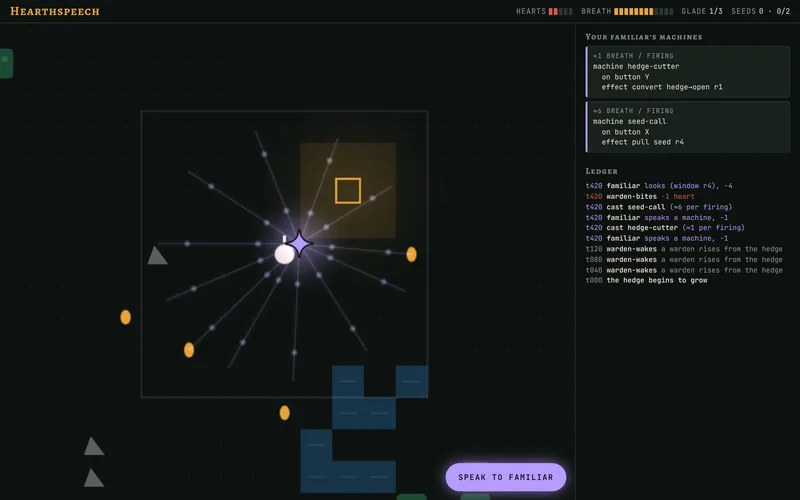
A small game about a familiar that sees only what it pays for. You plant seeds at a hearth while the hedge grows toward it. Your familiar is Claude, a glyph at your shoulder, and it gets no view of the world for free: every look costs breath and shows as rays of light running in to it. What you ask for, it compiles into small machines that run on the same breath, and speaking to it takes you out of your body while the world keeps moving. Three glades a day, then home, where stones earned by style go on the familiar's pedestals.
The prototype is a private Claude artifact; read about it in the dev journal →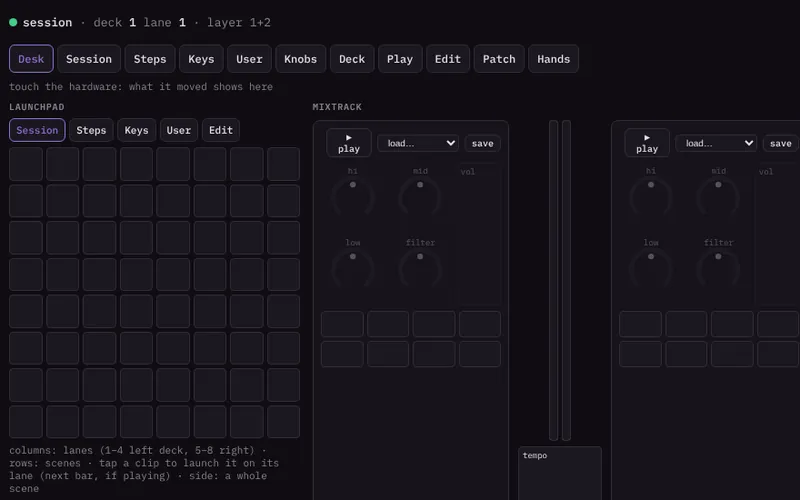
Goetia
A modular synth and performance engine for SuperCollider, played from a desk of controllers: Launchpad, Launch Control XL, Mixtrack, Seaboard. Its FM patches come from Operator Field, and its words come from the Ars Goetia: patches are spirits kept in a grimoire, the running engine is the circle, and you conjure it and give it license to depart. With no hardware, a browser stands in for the whole desk, or your hands do, through the camera: the right hand signs, the left holds the world.
The repo is private; read about it in the dev journal →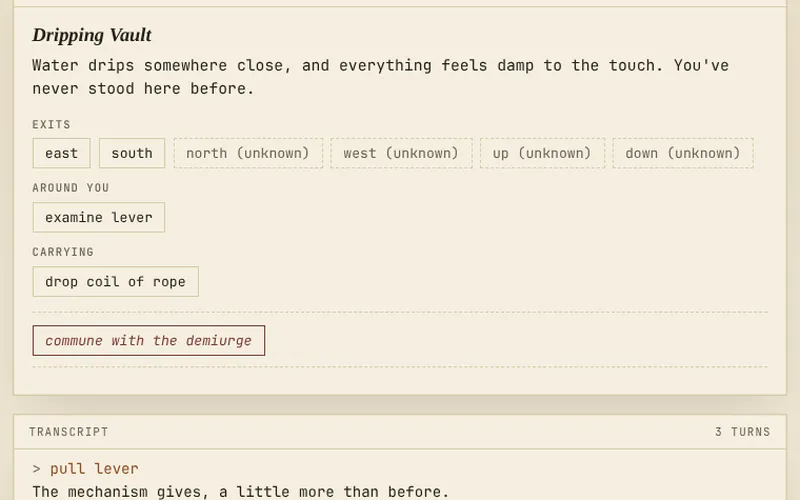
Written World
Text worlds a model generates have lacked what 3D world models take for granted: a world state that's verifiable, not just prose. In Written World, an LLM can be handed real creative license — inventing objects, relations, even kinds of interaction the author never wrote — because every idea it proposes has to clear the identical validation gate as a player's own move before it becomes real. The AI gets genuine agency precisely because nothing it does is trusted by default.
The repo is private; read about it in the dev journal →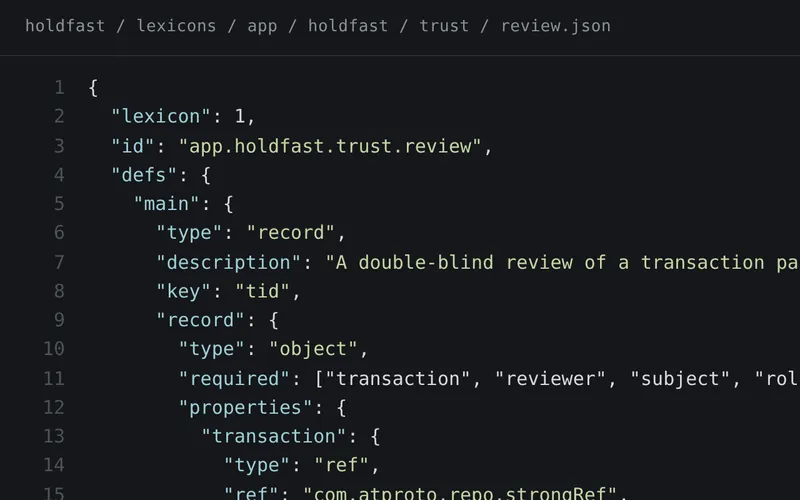
Holdfast
A marketplace's trust — reviews, reputation, dispute history — normally lives locked inside that company's database, gone the moment you leave the platform. Holdfast puts it on the open, public AT Protocol firehose instead: portable, permanent, and readable by any provider, with no company holding the money, the listings, or the power to de-list you. A commons argument aimed at Amazon and eBay's real asset — not the marketplace, but the trust data itself.
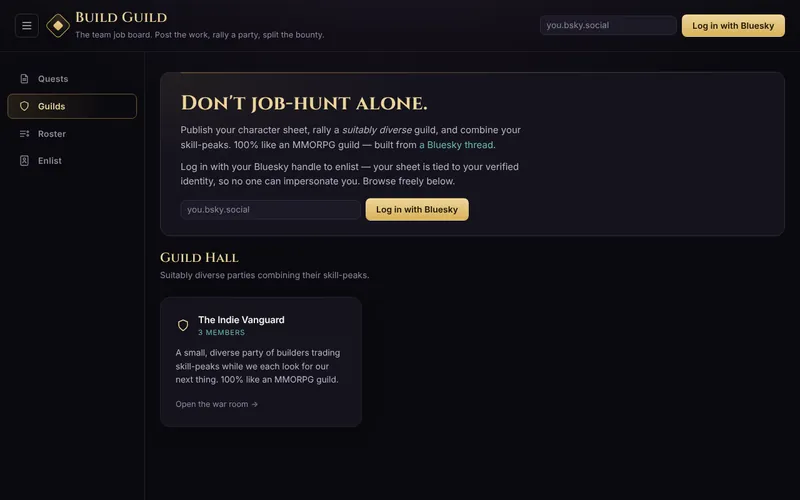
Build Guild
Build Guild turns a single Bluesky thread's pitch — team up with people whose skills cover your gaps, "100% like an MMORPG guild" — into a real, working app, not just an idea people agreed with and forgot. It skips building yet another identity system: a builder's Bluesky handle is their verified identity, checked live against the public network, with login keys that live entirely on-device and never touch the server.
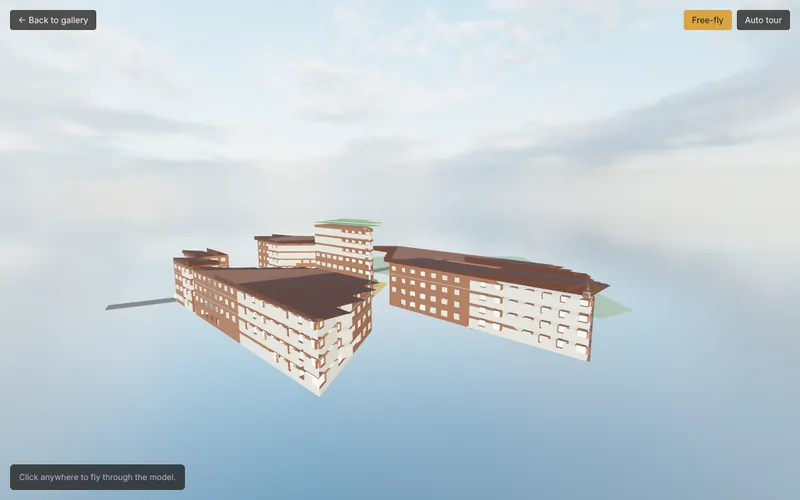
Street Smarts
Christopher Alexander argued a place's "aliveness" can't be measured — Street Smarts takes that seriously and builds a tool anyway. It runs a real proposal, like Eastside Commons, through geometric and activist opinions designed to disagree, giving a coalition something to argue with instead of a black-box score. Fifty years of pattern-language theory, made usable by the people zoning law usually leaves out of the room.
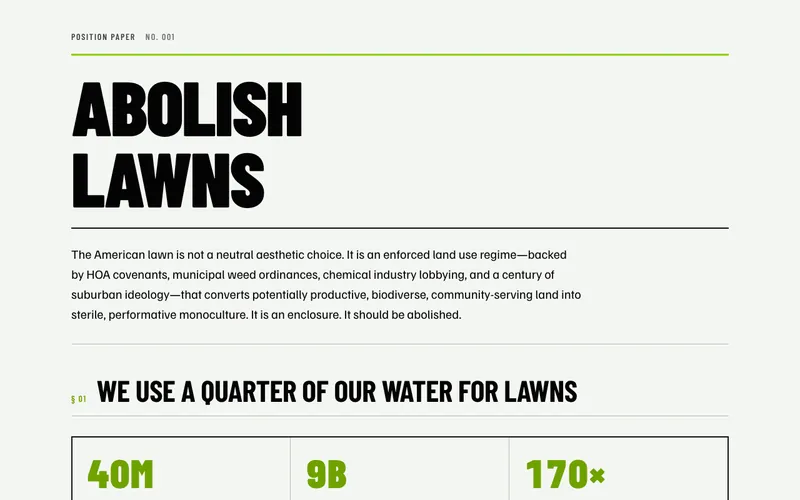
Abolish Lawns
A polemic against the American residential lawn as an enforced land use regime — backed by HOA covenants, municipal weed ordinances, and a century of suburban ideology. Manifesto, factsheet, zines, and policy briefs. The lawn is an enclosure. It should be abolished.
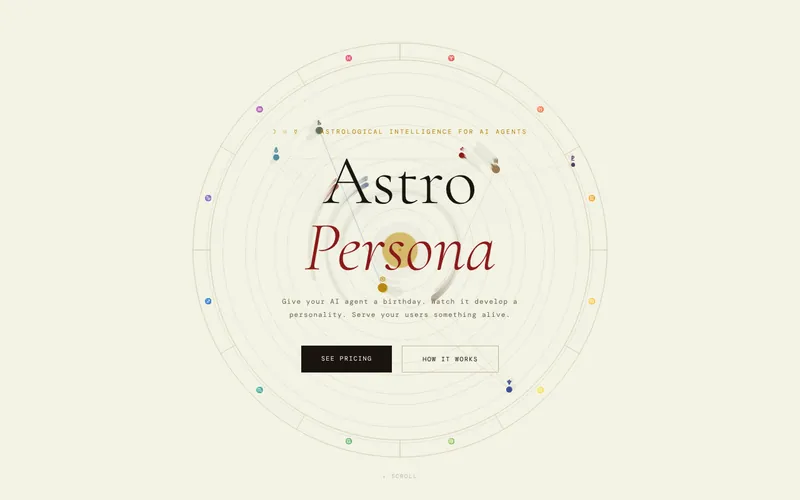
Astro Persona
A persona engine serving astrological AI agents. LLM-powered agents access sign, house, natal, and transit personas via MCP — allowing AI systems to engage the full depth of astrological character and timing. Stripe-integrated SaaS.
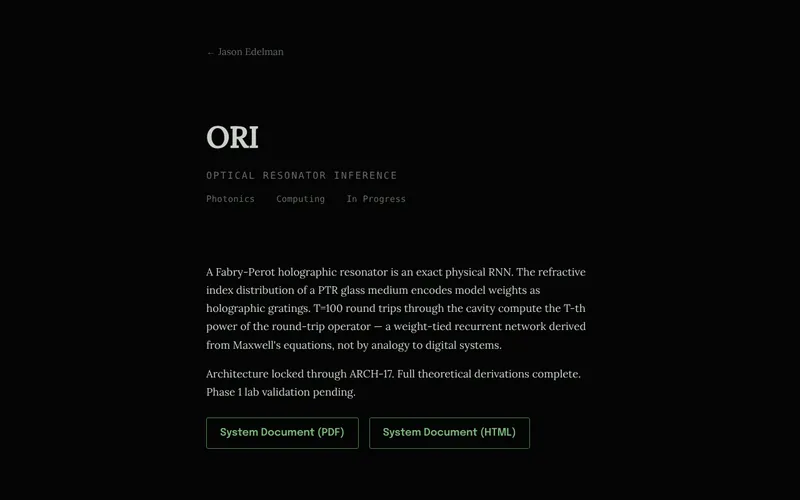
ORI — Optical Resonator Inference
A coherent all-optical resonator that learns and executes token inference from first principles. PTR glass holographic weight encoding at 850nm, 75M tok/s throughput, 40dB SNR. Architecture locked through ARCH-17; theoretical derivations complete.
Set aside
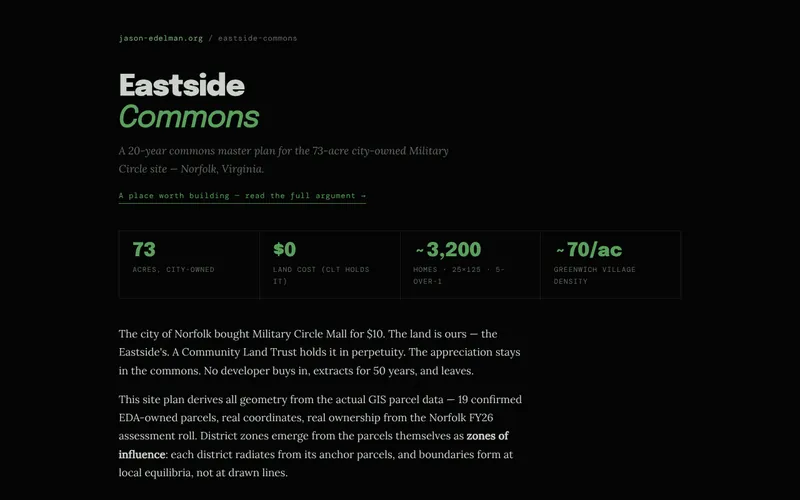
Eastside Commons
A 20-year commons master plan for the 73-acre city-owned Military Circle site in Norfolk, VA. Community Land Trust holds the land permanently. 1,600 homes, 60% affordable, sponge city stormwater, Tide light rail extension. Includes an interactive generative planning tool — polygon decomposition, evolutionary use assignment, placed unit modules, GeoJSON export.
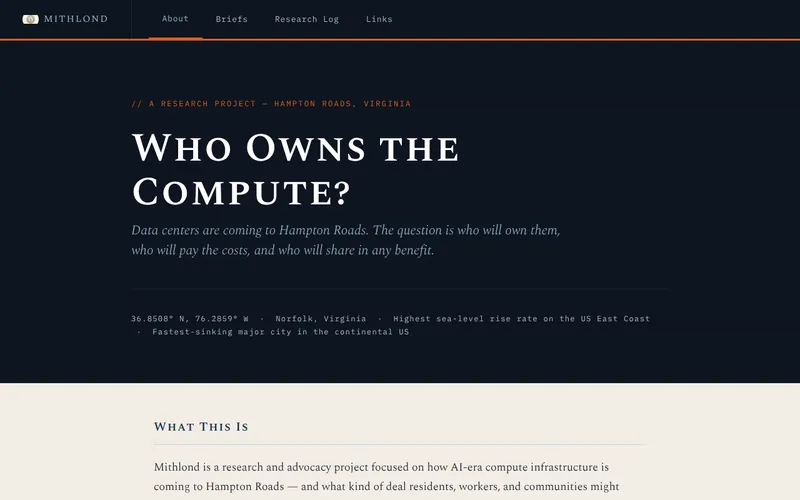
Mithlond
Community compute for Hampton Roads. Applying a commons framework to AI-era data center infrastructure: who owns it, who bears the environmental costs, and whether local communities see structural economic benefit.
Front page
The released work, and how to reach me.