Goetia: A DAW That Summons Its Instruments
October 12–27, 2026
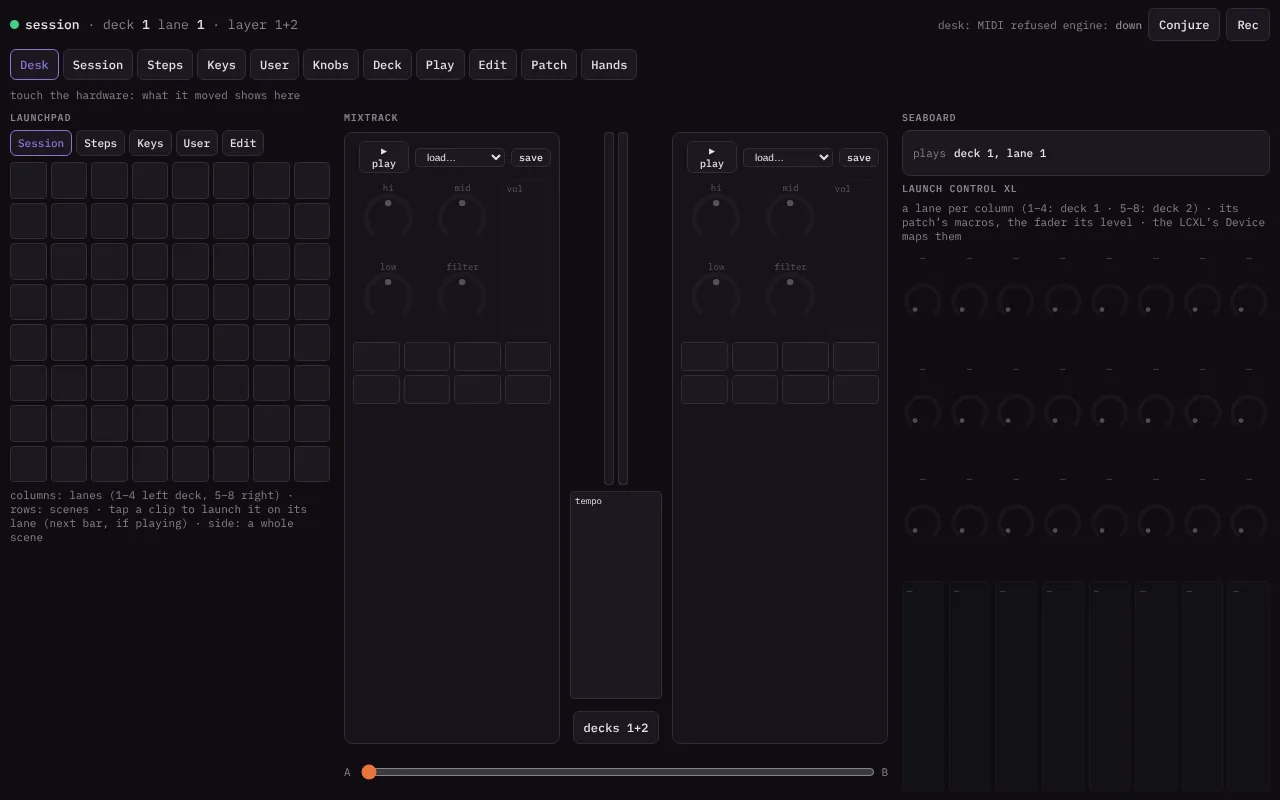
Goetia is a performance engine for SuperCollider, built around the controllers on my table instead of a screen. A Launchpad Mini is the step sequencer and picks scenes and patches. A Launch Control XL shapes the synth. A Numark Mixtrack 3 is the mixing console: two decks, a crossfader, live effects. A track is a SuperCollider script that binds patterns, macros and patch banks to the Mixtrack. I described all of it on the first day, the design document keeps it in my words, and the code has been reshaped to fit it since.
It's also the cyborg project in practice. I decide what it should feel like and play it. Claude builds it, tests what can be tested, and says plainly what it can't, because it can't touch the controllers or hear the sound. That split became a rule: no MIDI mapping counts as done until I've confirmed it on the desk.
Spirits and a circle
The name comes from the Ars Goetia, the first book of the Lesser Key of Solomon: a catalogue of spirits, each called into a circle and sent away with a license to depart. So a patch is a spirit, the shared bank is the grimoire, the running engine is the circle, and you conjure it and let it depart. The FM spirits come from Operator Field, the touch patch designer on this site. The theme has one limit: a name never wins over a control being obvious.
Under the theme sits one plain decision. Everything a controller can do is a verb on a path in SuperCollider's own node tree, and there's no second way in. The hardware, the browser and the hands all speak that one protocol.
Away from the desk
I spent the first days traveling with only the laptop and my phone, so the first instrument I could play wasn't the desk. The familiar is a browser page that stands in for every controller, and through the laptop camera it became a hand instrument: the right hand signs, the left holds the world. The first grammar treated hands as direct controls. I wanted something else, hands as operators in a drawn program space, so each deck became a circle with its lanes around it as spirits.
On the desk
Back in Norfolk, the hands grew a hypertheremin, eight dimensions read from two hands, and then the hardware met Windows. After Goetia sent the Launchpad a SysEx message, Windows MIDI Services hung and the pads went silent. The fix became a rule: plain notes and control changes only, with one later exception for switching the Launchpad back into its programmer mode when it reconnects. That same evening the first jam ran a Freesound field recording of a metal door in wind, reversed, pitched down about nineteen semitones, looped and low-passed. The sequencer worked. The next day the controllers moved to the browser's Web MIDI, and on Windows SuperCollider now opens no MIDI at all.
The repo is private for now.