Written World: A Text Adventure You Can Check
August 5–6, 2026
When a language model generates a text world, the world lives in prose. Once a room has been described, the description is all there is, and nothing checks it. Hand-written games like Zork always kept structured state underneath, and 3D world models keep a state you can inspect and verify; generated text worlds generally don't. Written World was my attempt to give generated text that property. I'd talked the design through, slept on it, and decided to build it, with Rust for the engine and WebAssembly for the browser.
The first version, built that day, made one rule absolute: nothing changes the world except a batch of changes that validates against the schema before any of it commits. Prose is never stored. It's rendered fresh from state every time, so revisiting a room returns byte-identical text. A locked exit could come with a lever and a generated rule linking the two, which was the point: generated rules, not just generated content.
A graph, and machines instead of verbs
Later that day it was rebuilt on a reified RDF graph. Rooms, items and the rule linking a lever to a door are all triples. The fixed vocabulary is small, and any other relation has to declare itself before the validator will accept it; the declaration is just another triple. There's no list of verbs either. A machine is a node equipped to a thing, with a trigger verb, requirements and an effect, and the player perceives and acts through a sight-machine and a hands-machine. Perception and action are the same mechanism, run in opposite directions.
Generation comes from a demiurge whose proposals pass through the same gate as anything else. A second demiurge, backed by Workers AI, answers only when the player chooses to commune with it: the model proposes a few new facts about the room, sometimes a relation the vocabulary never had, and its output is exactly as untrusted as a player's input. Every commit lands in a transcript tagged with who proposed it, and the tag is recorded, not trusted. Patterns crystallize, too. The first door mechanism stays a nameless "mechanism"; only when the same shape recurs does it earn a shared kind, "lever". The matching behind that is still a hardcoded stand-in for real interface congruence, and the README says so.
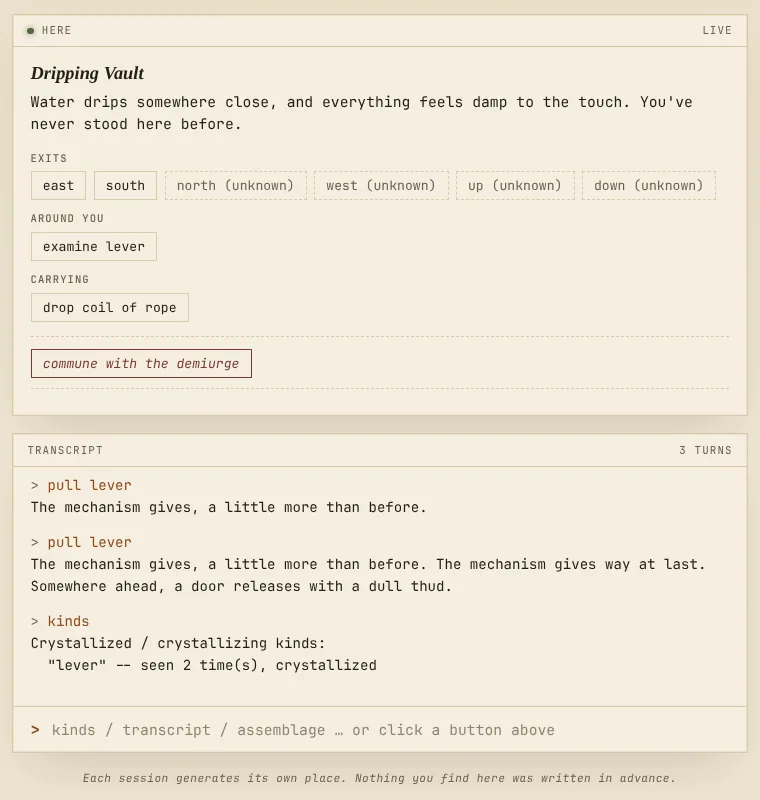
kinds reports that "lever", seen twice, has crystallized.The second day
On day two the engine moved server-side into a Cloudflare Durable Object. The browser became a thin view, the world persists as an N-Quads snapshot that survives a reload, atproto OAuth sign-in was built (finishing a login needs a public deploy), and communing became a petition: a pub/sub queue that lives in the graph itself, so the queue never decides who answers. Work continued on another branch after that. The repo is private for now.